
One Savior. One Atonement. One Hope.
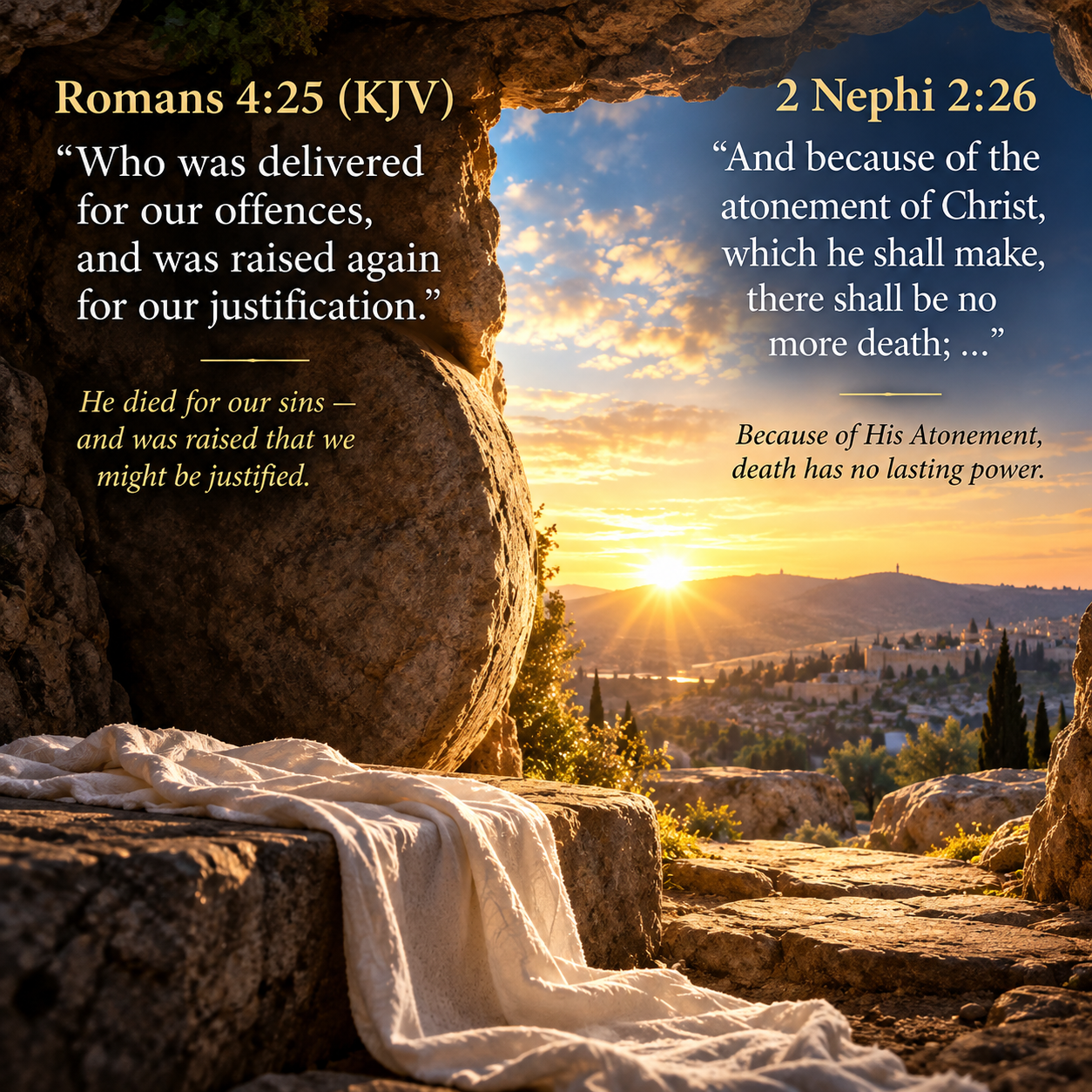
Paul declared:
“Who was delivered for our offences, and was raised again for our justification.”
— Romans 4:25
And Lehi taught:
“And because of the atonement of Christ… there shall be no more death.”
— 2 Nephi 2:26
Two witnesses, separated by centuries, testify of the same central truth: Jesus Christ died for us and was raised again.
His Atonement addresses our sins, and His Resurrection breaks the power of death.
The message is remarkably simple: Christ is our Redeemer, and through Him we have hope of life beyond the grave.
The Bible and the Book of Mormon bear witness of the same Lord.
One Sacrifice. One Savior. One Hope
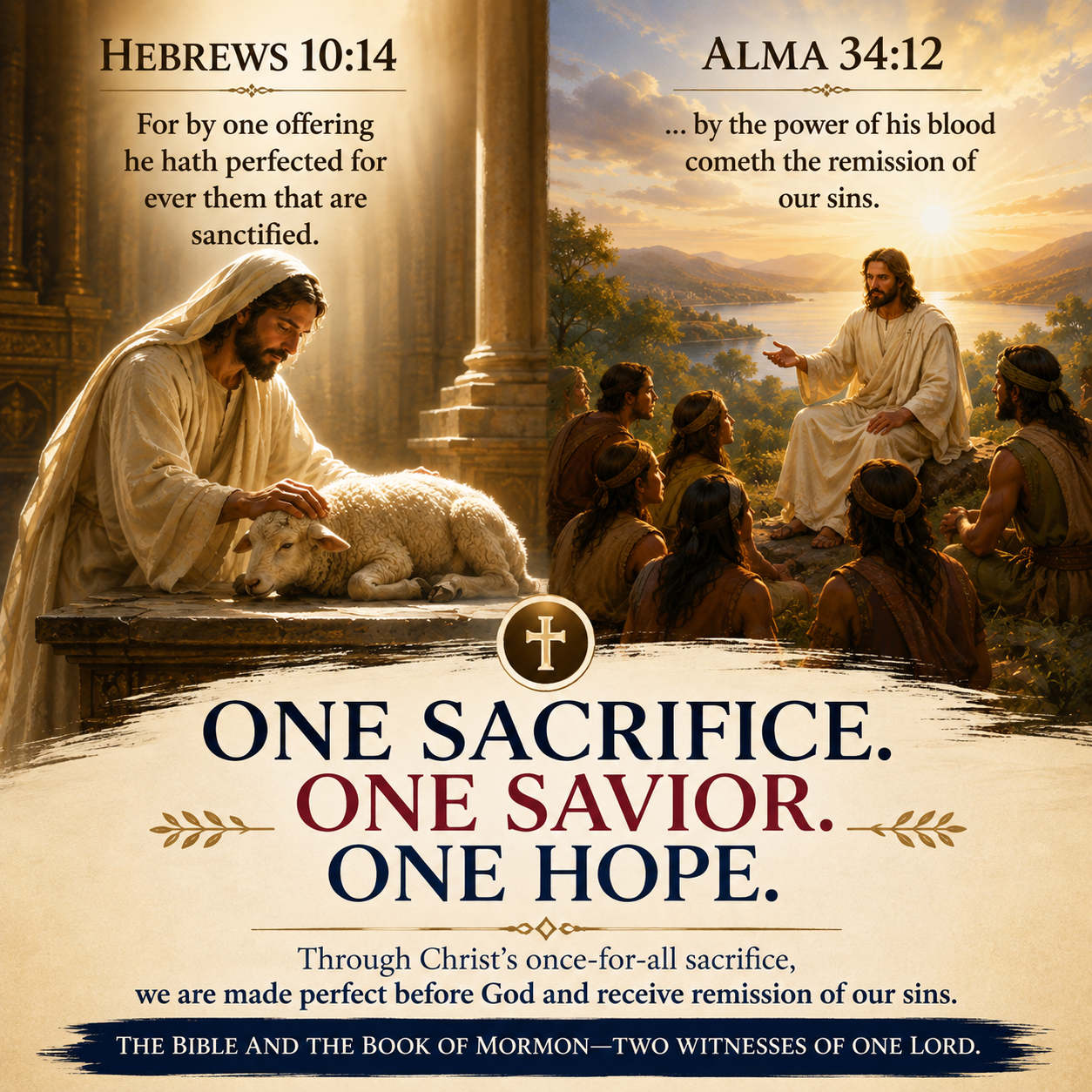
One Sacrifice. One Savior. One Hope.
The Bible and the Book of Mormon testify of the same powerful truth:
“For by one offering he hath perfected for ever them that are sanctified.”
— Hebrews 10:14
And Alma taught:
“There is no man that can sacrifice his own blood which will atone for the sins of another… but by the power of his blood… cometh the remission of our sins.”
— Alma 34:11–12
The answer to sin was never found in an endless system of sacrifices, nor in the blood of animals, nor in the works of men.
It is found in Jesus Christ.
His offering was sufficient.
His blood brings remission of sins.
His sacrifice was once for all.
The Bible and the Book of Mormon stand together as two witnesses of one Lord and one redeeming sacrifice.
Our hope is not in what we can offer God. Our hope is in what Jesus Christ has already offered for us.
#JesusChrist #Bible #BookOfMormon #Hebrews1014 #Alma3412 #Atonement #RemissionOfSins #GospelOfChrist #FaithInChrist #TwoWitnessesOfOneLord
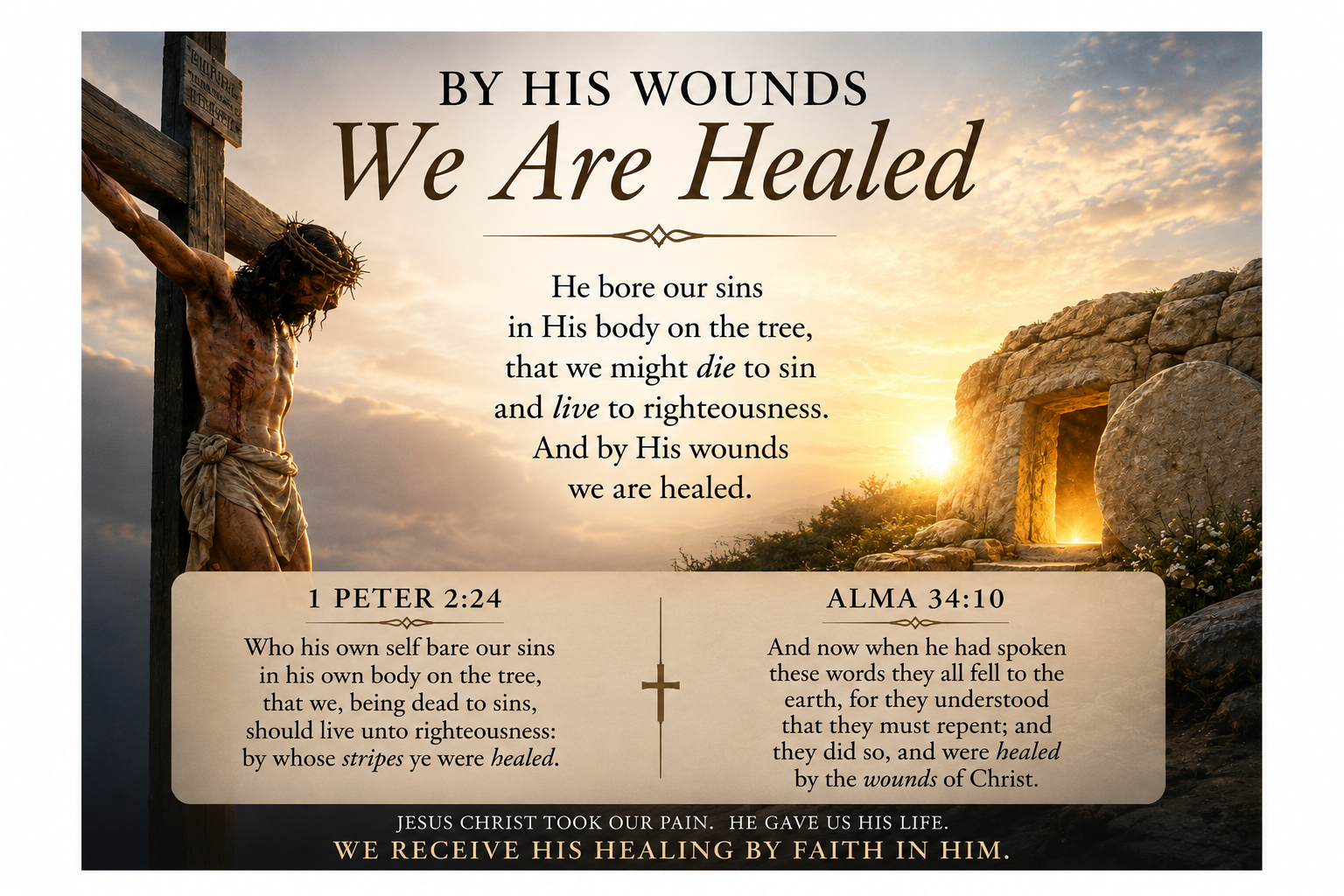
Jesus Christ did what no other sacrifice could do. He bore our sins in His own body, that we might die to sin and live unto righteousness.
Peter testified:
“By whose stripes ye were healed.” — 1 Peter 2:24
Alma taught the same truth:
“They were healed by the wounds of Christ.” — Alma 34:10
The Bible and the Book of Mormon bear one witness of one Lord: our salvation and healing come through Jesus Christ.
His sacrifice was not merely an example of love—it was the means by which He overcame sin and made healing possible for us.
Look to Christ. Trust in Him. Repent and live unto righteousness.
#JesusChrist #Bible #BookOfMormon #DoctrineOfChrist #FaithInChrist #AtonementOfChrist #ByHisWoundsWeAreHealed
By His Wounds, We Are Healed
Jesus Christ did what no other sacrifice could do. He bore our sins in His own body, that we might die to sin and live unto righteousness.
Peter testified:
“By whose stripes ye were healed.” — 1 Peter 2:24
Alma taught the same truth:
“They were healed by the wounds of Christ.” — Alma 34:10
The Bible and the Book of Mormon bear one witness of one Lord: our salvation and healing come through Jesus Christ.
His sacrifice was not merely an example of love—it was the means by which He overcame sin and made healing possible for us.
Look to Christ. Trust in Him. Repent and live unto righteousness.
#JesusChrist #Bible #BookOfMormon #DoctrineOfChrist #FaithInChrist #AtonementOfChrist #ByHisWoundsWeAreHealed
The Church Is More Than a Building
When Jesus said, "I will build my church" (Matthew 16:18), He wasn't speaking about constructing buildings. He was speaking about gathering a people.
Both the Bible and the Book of Mormon teach that the Church is a covenant community centered on Jesus Christ. It is a place where believers are united by faith, strengthened through fellowship, nourished by truth, and bound together through covenant relationships.
In a world that increasingly celebrates individualism, scripture reminds us that discipleship was never intended to be a solitary journey. Christ gathers His people into one body. He teaches them, strengthens them, and invites them to bear one another's burdens.
The true Church is not merely an institution—it is a people who have come unto Christ, taken His name upon them, and seek to follow Him together. As Chapter 6 concludes:
"The Church is not merely an institution but a gathered people — baptized into Christ, united by faith, sustained by the Spirit, and called to live as one body under one Lord."
What role has a community of faith played in your walk with Christ?
#JesusChrist #Bible #BookOfMormon #ChristianDiscipleship #FaithInChrist #CovenantCommunity #ScriptureStudy #ChristianLiving #LDSBooks #AuthorJonDaich
Who Is Jesus Christ? The Eternal Son, the God of Israel, and the Word Made Flesh
Every doctrine of Christianity ultimately rests upon a single question: Who is Jesus Christ?
If Jesus were merely a prophet, His words would offer guidance. If He were only a moral teacher, His life would provide an example. But if He is who the scriptures declare Him to be—the Eternal Son of God, the God of Israel, and the Word made flesh—then His mission carries eternal significance for every person who has ever lived.
The Bible and the Book of Mormon unite in bearing witness of this remarkable truth.
The Eternal Son
The Gospel of John opens with one of the most profound declarations in scripture:
"In the beginning was the Word, and the Word was with God, and the Word was God."
John does not introduce Jesus as someone who came into existence at Bethlehem. Instead, he reaches back before creation itself and reveals that Christ already existed. Before the earth was formed, before Abraham, before Moses, Christ was.
The Apostle Paul teaches that all things were created by Him and for Him. Christ is not part of creation; He is its Creator. He stands at the beginning of history and remains unchanged throughout eternity.
The Book of Mormon echoes this same testimony. When the brother of Jared encountered the premortal Christ, the Lord declared:
"Behold, I am Jesus Christ... I was prepared from the foundation of the world to redeem my people."
Redemption was not an afterthought. The mission of Jesus Christ was established before the world began.
The God of Israel
One of the most striking themes found in both the Bible and the Book of Mormon is the identification of Jesus Christ as the covenant God of Israel.
In Isaiah, the Lord declares:
"I am the first, and I am the last; and beside me there is no God."
Yet in Revelation, the risen Christ announces:
"I am Alpha and Omega, the beginning and the end, the first and the last."
The same divine titles belonging to Jehovah are applied directly to Jesus Christ.
The Book of Mormon is equally clear. After His resurrection, Christ appeared to the Nephites and declared:
"I am Jesus Christ... I am the God of Israel."
This is a remarkable witness. The Lord who covenanted with Abraham, Isaac, and Jacob is the same Lord who came into mortality, suffered for the sins of the world, and rose again in glory.
The Bible and the Book of Mormon do not present two different Gods. They present one Redeemer—the God of Israel revealed in Jesus Christ.
The Word Made Flesh
Perhaps the greatest miracle of all is found in John's declaration:
"And the Word was made flesh, and dwelt among us."
The Creator entered His creation.
The Eternal Son took upon Himself mortality. He experienced hunger, fatigue, sorrow, suffering, and death. Yet He remained who He had always been—God.
The Book of Mormon describes this event as "the condescension of God." King Benjamin taught that the Lord Omnipotent would come down from heaven and dwell among the children of men. Abinadi declared that God Himself would come down to redeem His people.
These teachings reveal a profound truth: God did not remain distant from human suffering. He entered it.
Jesus Christ knows our weaknesses because He experienced mortality firsthand. He understands pain because He bore it. He can redeem because He willingly descended below all things.
Why This Matters
Understanding who Christ is changes everything.
Because He is eternal, His atonement has eternal power.
Because He is the God of Israel, His covenant promises can be trusted.
Because He became flesh, He can perfectly understand and redeem humanity.
The scriptures testify that Jesus Christ is not merely a historical figure. He is the Eternal Son, the covenant Lord of Israel, and the Word made flesh. He is the Creator who became Redeemer, the God who descended among His people, and the risen Lord who reigns forever.
The central message of both the Bible and the Book of Mormon is the same:
Jesus Christ is the Eternal God who came to save His children.
And because of Him, every person may receive forgiveness, covenant blessings, resurrection, and eternal life.

Turn Intention Into Action
It All Begins Here
Confidence doesn’t always arrive with a bold entrance. Sometimes, it builds quietly, step by step, as we show up for ourselves day after day. It grows when we choose to try, even when we’re unsure of the outcome. Every time you take action despite self-doubt, you reinforce the belief that you’re capable. Confidence isn’t about having all the answers — it’s about trusting that you can figure it out along the way.
The key to making things happen isn’t waiting for the perfect moment; it’s starting with what you have, where you are. Big goals can feel overwhelming when viewed all at once, but momentum builds through small, consistent action. Whether you’re working toward a personal milestone or a professional dream, progress comes from showing up — not perfectly, but persistently. Action creates clarity, and over time, those steps forward add up to something real.
You don’t need to be fearless to reach your goals, you just need to be willing. Willing to try, willing to learn, and willing to believe that you’re capable of more than you know. The road may not always be smooth, but growth rarely is. What matters most is that you keep going, keep learning, and keep believing in the version of yourself you’re becoming.

Make Room for Growth
It All Begins Here
Confidence doesn’t always arrive with a bold entrance. Sometimes, it builds quietly, step by step, as we show up for ourselves day after day. It grows when we choose to try, even when we’re unsure of the outcome. Every time you take action despite self-doubt, you reinforce the belief that you’re capable. Confidence isn’t about having all the answers — it’s about trusting that you can figure it out along the way.
The key to making things happen isn’t waiting for the perfect moment; it’s starting with what you have, where you are. Big goals can feel overwhelming when viewed all at once, but momentum builds through small, consistent action. Whether you’re working toward a personal milestone or a professional dream, progress comes from showing up — not perfectly, but persistently. Action creates clarity, and over time, those steps forward add up to something real.
You don’t need to be fearless to reach your goals, you just need to be willing. Willing to try, willing to learn, and willing to believe that you’re capable of more than you know. The road may not always be smooth, but growth rarely is. What matters most is that you keep going, keep learning, and keep believing in the version of yourself you’re becoming.